Every collection starts the same way. One shirt, maybe two, each with a story you could tell without thinking. The Italia 90 third kit your dad bought you. The shirt you queued three hours for outside the club shop the year you won the league. You know exactly where each one is and exactly why it matters.
Then you hit shirt number twenty. Then thirty. Suddenly you're not sure if you've already got the 1998 away kit or just nearly bought it twice. A duplicate turns up at the bottom of a box. A shirt you swore was a player issue turns out to be a standard replica with the wrong tagging. This is the point where most collectors realise they need a proper system, not just a memory and a wardrobe, and where learning how to catalogue your football shirt collection with Showboat starts to make sense.
Why football shirts are harder to catalogue than they look
On paper, cataloguing sounds simple. Write down what you've got. Job done. But football shirts carry more detail than most collectables, and that detail is exactly what determines value and rarity.
Take a single season for a single club. There might be two or three sponsor variations. A long sleeve version that never got the same retail push as the short sleeve. A player issue cut differently to the replica, with different badges, different fabric, sometimes a different manufacturer crest altogether. Get one of those details wrong in your own records and you can spend years thinking you own something you don't, or worse, sell something far more valuable than you realised.
Shirts also shift in meaning over time. A kit that felt unremarkable when it launched can become iconic a decade later because of one campaign, one player, one moment. Tracking your collection properly means tracking that context too, not just club and season.
Why a spreadsheet only gets you so far
Most collectors start with a spreadsheet, and it works fine at first. Club, season, size, maybe a photo saved somewhere else. But spreadsheets don't know anything. They won't flag that you've bought the same Roma away kit twice under two different listing titles. They won't tell you that your row of 1980s Juventus shirts actually completes a known run that collectors specifically look for.
There's also the gap between the shirt and the record. The shirt lives in a drawer. The spreadsheet lives on a laptop. Over time the two drift apart, you stop updating it, and you're back to relying on memory again, which is the exact problem you were trying to fix. This is usually the moment collectors start looking for a proper football shirt collector app instead.
What proper cataloguing actually involves
A collection that's properly catalogued captures more than club and year. For each shirt you want club, season, manufacturer, sponsor version, sleeve length, condition and any unique detail that separates it from a standard retail copy.
Beyond the basics, it's worth noting how each shirt fits into your wider collection. Does it complete a home and away pair? Is it part of a run you're building season by season? Did you buy it because of a specific player or a specific match? None of that shows up in a basic spreadsheet column, but it's often the reason the shirt matters to you in the first place.
Done properly, this kind of tracking also shows you your own habits. If half your collection is one club from one decade, you'll see it. If you keep nearly buying the same shirt twice, you'll catch it before it happens a third time.
Why a football shirt collector app changes things
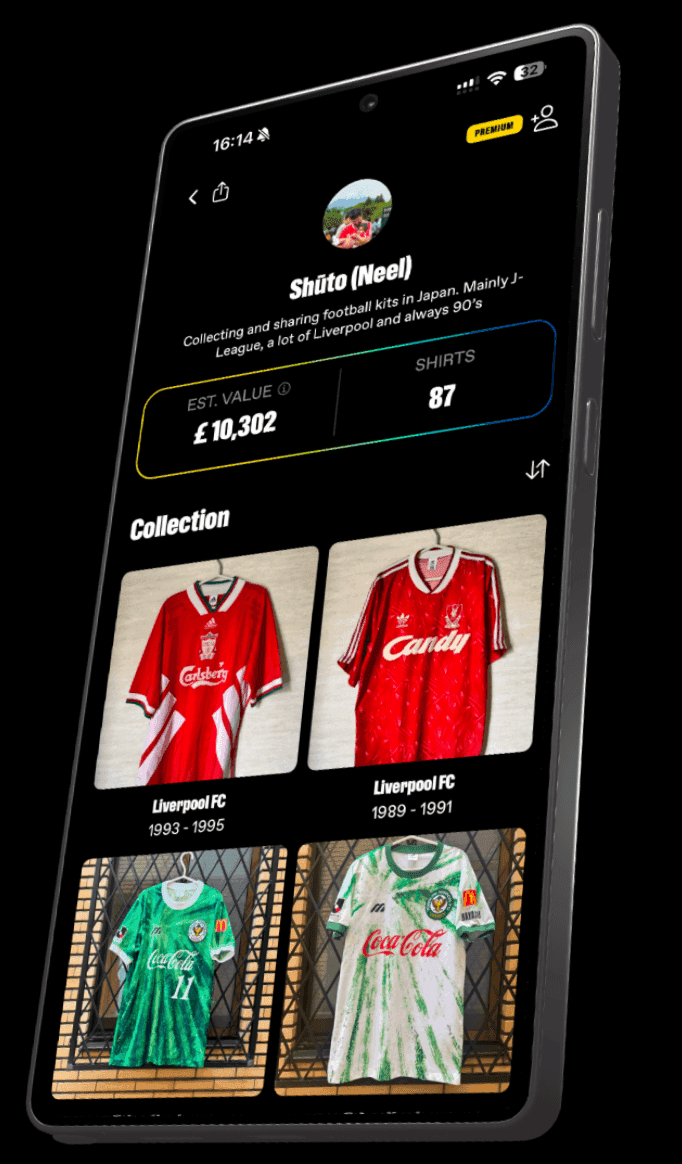
This is where Showboat does what a spreadsheet can't. As a dedicated football shirt collector app, it connects every shirt you log to real market data, recent sales and what other collectors are tracking. Add a shirt and you can see straight away how it's trending, what similar shirts have sold for, and how rare it actually is against the wider market, not just against your own collection.
That matters because collectors are not always the most objective judges of their own shirts. A kit with personal history can feel rarer or more valuable than it is. Real data doesn't take the sentiment away, it just gives you something solid to weigh it against.
How Showboat handles the cataloguing for you
Showboat is built around the way collectors actually think. Upload a photo, fill in the details, and it gets matched against a database of verified shirts and current valuations, so you're not flicking between three eBay tabs and a forum thread trying to work out if your kit is the rare version or the common one.
You can browse by club, by decade, by league, or by tags you set yourself. If you're working through a specific run, say every Fiorentina home shirt from the 90s, Showboat shows you what you've got and what's still missing. And if you ever want to sell or trade, the valuation and the listing sit in the same place, so you're not rebuilding a description from scratch. It's this combination, proper cataloguing plus live market data, that makes it the most useful football shirt collector app for anyone serious about their collection.
Make it a habit, not a backlog
The app only works if you actually use it. The easiest way is to log a shirt the moment it arrives, before it goes in the drawer. If you're catalogued retroactively, do it in batches, one box or one shelf at a time, rather than trying to get the whole collection done in one sitting.
It doesn't need to feel like admin. Most collectors end up doing it while watching a match or after a trip to a football fair, a few shirts at a time.
Seeing the bigger picture
Once your collection is properly logged, patterns start to show up that you'd never spot from memory alone. Maybe you've quietly built a strong run of underdog teams, or you've gone deep on one specific era of Serie A kits without really planning to. That kind of insight is useful if you're thinking about where to focus next, or whether it's time to thin out the shirts you don't really wear or display anymore.
Cataloguing isn't about turning a hobby into admin work. It's about making sure the stories behind your shirts don't get lost as the collection grows. Showboat just makes sure that, while you're adding to the pile, you're not losing track of what's already there.
If your collection has reached the point where you can't remember what you own without checking, it's worth getting it properly catalogued. Download Showboat, the football shirt collector app built for exactly this, for iOS or Android, and get your collection in order.
Related Reading
Football Shirt Valuation: A Collector's Guide
The Best Football Shirt Collector App