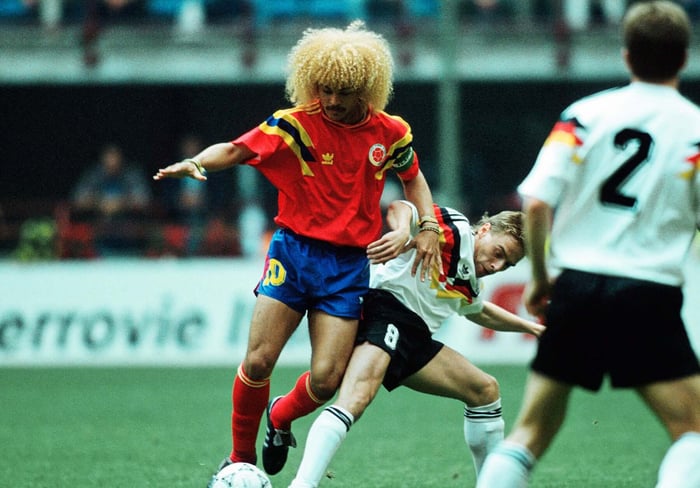
Carlos Valderrama. El Pibe. The blond curls, the wide smile, the effortless swagger. He was a footballer most people remember not for what he won but for what he gave. He gave joy to everyone who saw him play. He left you rooting for him even as your team played against him.
Born in Santa Marta on Colombia's Caribbean coast, Valderrama played with a natural breeze that no coach could have taught him. He rose through Union Magdalena before moves to Millonarios and Deportivo Cali, and by the mid-1980s he was already the heartbeat of the Colombia side, the number 10 whose permed halo of hair made him recognisable from the halfway line. Unmanageable at times, it often felt, but also undeniable.
Europe eventually got its glimpse of him up close. At Montpellier in France he lifted the Coupe de France in 1990, and he later spent a spell at Real Valladolid in Spain, where he was admired without ever quite being understood. European football wanted urgency from its midfielders, and Valderrama offered patience instead, dictating tempo from deep with a metronomic calm that could look almost indifferent until you noticed how completely he controlled the game around him. It worked well enough, but it never defined him the way South America did.
No matter, because Valderrama was never really about Europe. He was about Colombia, about South America, about World Cups. He played in three of them (1990, 1994 and 1998), wearing the armband for a golden generation that promised the world and, in Italy in 1990, came close to delivering it. The 5-0 win away to Argentina in Buenos Aires in 1993 remains one of the great performances by any Colombian side, and Valderrama sat at the centre of it, orchestrating everything. Even when the results disappointed, most painfully in 1994, the affection people felt for him personally never wavered.
Later, in Major League Soccer, he became an icon all over again. He played for Tampa Bay Mutiny and Miami Fusion before winning MLS Cup with Colorado Rapids in 1997, and he brought a flair and theatre to a young league that hadn't seen much of either. He never treated the United States as a retirement posting. He saw it as another stage worth performing on, and fans who had barely heard of Colombian football, who couldn't have named a single player from that 1994 squad, found themselves enchanted by a midfielder in his thirties who still saw passes nobody else could.
And then there was the man himself. Charisma radiated from him wherever he went. He looked like a showman but played like a craftsman, all patience beneath the theatre, and his interviews, his jokes and his warmth were a reminder that football at its best isn't only about trophies. It's about joy, about connection, about spectacle, and Valderrama understood that better than almost anyone of his generation.
He didn't conquer Europe, and he didn't lift the biggest trophies, and none of that mattered in the slightest. He gave something else instead: a sense of fun, of football as art, proof that greatness isn't always measured in medals but sometimes in memories, in the way a player made you feel, in the grin you wore when you watched him play.
Carlos Valderrama. One of one.