We’ve known Rob Armin for a while now. Long before The Soccer Archive became one of the biggest names in the vintage football shirt world, he was the bloke everyone seemed to know had seen it all.
Growing up in Sheffield, Rob’s obsession with football shirts started young, before turning into a 13-year career at Classic Football Shirts. During that time he travelled the world sourcing some of the rarest match-worn shirts in existence, worked directly with former players and built a reputation as one of the most knowledgeable people in the game.
Today, he’s one half of The Soccer Archive, a business that’s become synonymous with authenticity, great curation and some of the finest shirts you’ll find anywhere. He's also, without doubt, one of the soundest blokes we've met in years. We caught up with Rob to talk about where it all began, why he no longer owns a single football shirt, and how a lifelong obsession became a career.
How did your interest in football shirts start?
I got my first football shirt when I was about three or four. Parents buying me Sheffield United shirts and that. But it really got going when I was about ten.
Like a lot of people born in the 80s, football shirts turned up in two places: JJB Sports and Stolen From Ivors. You’d walk in, and there’d be Nike Dortmund Nike, adidas Euro 96 templates from Turkey and Romania, long-sleeved Dortmund shirts for £10 or £15. JJB had J. League stuff, Kappa Barcelona, Munich 1860, really nice but obscure stuff.
Then I went to Rhodes and found a 97/98 AEK Athens shirt in a local sports shop. Crazy yellow and black design, local Greek bank sponsor, you couldn’t read, Kappa branded. Sheffield United had just signed Vasilis Borbokis from AEK and I remember thinking, “We’ve signed this exotic Greek lad. This is incredible.” He had the little wooden necklace and everything. We didn’t have players like that.
From there, it just snowballed. I had an unnecessary obsession with football shirts. Probably not medical, but unnecessary.
And that eventually leads to CFS?
Yeah. I started buying and selling back in the mid 00s around the time Classic Football Shirts had just started. I moved to Manchester, and the natural progression was to get a job there.
I worked at Classic Football Shirts for about 13 years. After a couple of years, I started reaching out to footballers to buy from them directly. That changed my role there. It had me flying all over the world, meeting Ballon d’Or winners and basically going through famous people’s lofts.
It was treasure hunting. World Cup final shirts, Champions League final shirts, stuff hidden from the public eye that these lads had no real interest in selling until someone asked.
I was responsible for buying all the match-worn shirts Classic Football Shirts had.
When did The Soccer Archive start to feel like the thing?
Early 2020s. I’d semi-left Classic Football Shirts and was working with a design agency that a friend and I had started. I just had this feeling of imposter syndrome. I was in this design space thinking, “I’m a football shirt guy. I can spot one from 100 metres away. That’s what I do.”
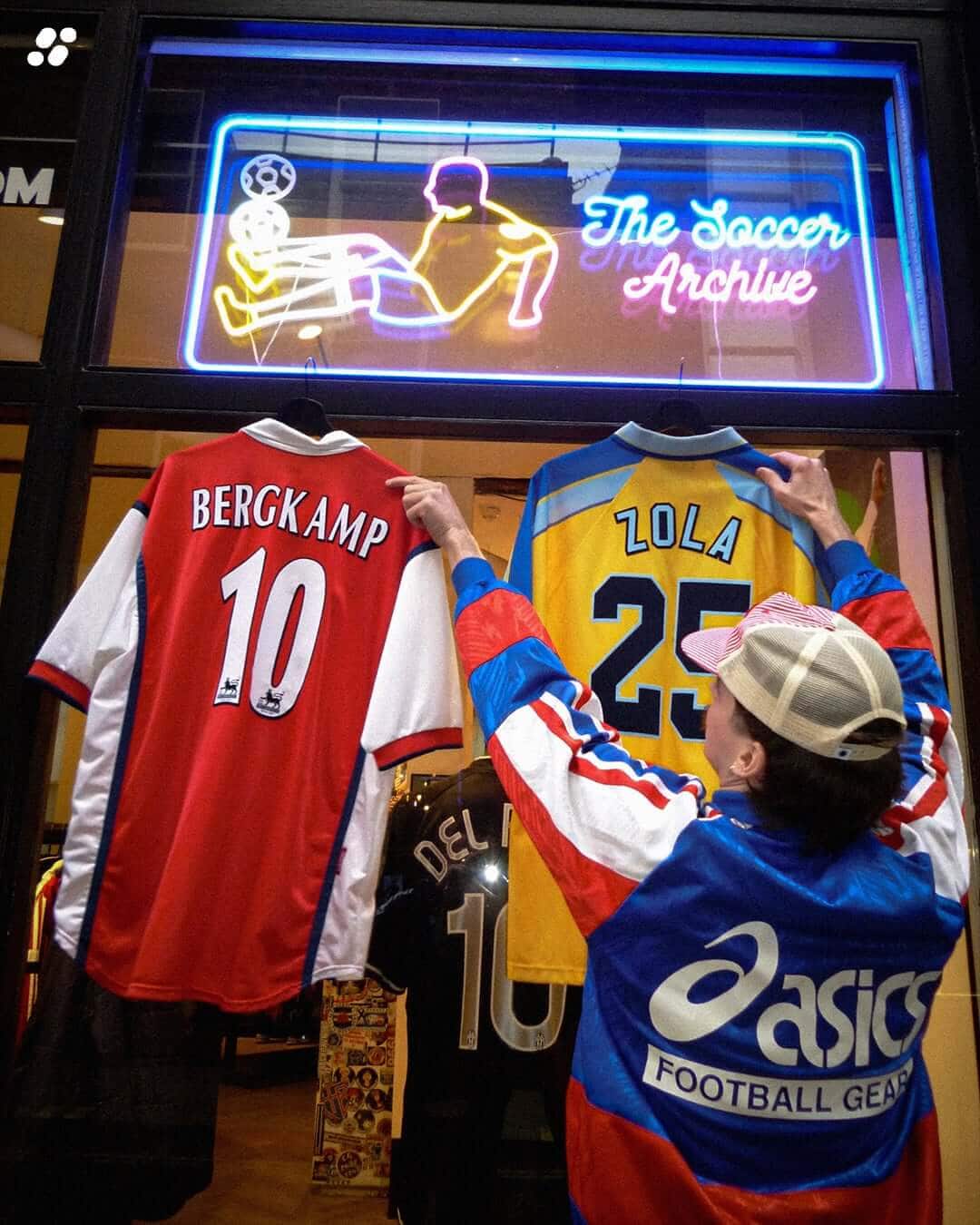
So, a former colleague and I, who had also been at Classic Football Shirts, started doing our own thing. We did a couple of pop-ups in London, launched the website, and now we’ve got the website, a shop in Soho and a shop in Milan.
How daunting was it moving from pop-ups to permanent shops?
To be honest, it was quite natural.
We ran pop-ups near Oxford Street, and some days were really strong. Then what really kicked us into gear was the need for a public space for the Euros. We found a space in Soho, it went well, and we got the opportunity to keep it. So we did.
It wasn’t some huge, dramatic decision. It just felt like the next step.
And Milan?
Milan made the decision for us.
Paolo is from Bergamo, he’s an Atalanta fan, and he moved back to Italy. Bergamo is 40 minutes from Milan, so we had someone on the ground. We had London, he had Milan. They’re the two most relevant cities in our respective countries, so it made sense.
It’s going well. There’s so much football tourism there. People fly in from Northern europe. In a couple of hours you’ve got Atalanta, Cremonese, Genoa, Juventus, Inter, AC Milan, Sampdoria. People come over for four days and take in three games.
Italians are obsessive about football, too, obviously. But it’s funny explaining how a lot of us got into Italian football. For them, it’s just their football. For us, it’s a bald bloke in a piazza with an espresso and a pink Gazzetta.
How is the business split between online and physical channels?
It’s probably 60/40 in favour of online.
The website does really well, which is good. The shops are important, but COVID taught everyone that you can’t rely only on having a physical store. You don’t know what’s happening tomorrow. So the website has to drive it.
How do you build a reliable supply network?
Trust and time.
But it’s difficult, because even when you find a good supplier, they’re always speaking to other people too. We get people coming into the shop or emailing saying, “We currently supply X, Y and Z, are you interested?”
So you’ve got to stay on your toes. Keep suppliers on your side, but always keep looking for new ones.
Is buying instinctive or data-driven?
Instinctive. But there’s subliminal data in there.
Take the World Cup. You’re not sitting there with a spreadsheet going, “We need X amount of this team.” But you know the World Cup is coming and you know what people will start looking for. So it’s instinctive, but there’s a thought process behind it.
How does your personal taste line up with what sells?
1You have to step outside yourself.
What you like doesn’t always convert. Pre-name-set shirts, so 1992 and earlier, don’t move like they used to. Germany 1990, Arsenal 1989, those iconic shirts all have high value now, but they can sit around.
What kind of collector are you now?
I collect records these days. Not football shirts.
I don’t own a single football shirt anymore. Like a lot of people, I started by selling my collection. My collection became my first round of stock. Once that was gone, everything after that was stock.
I had the France 2011 away for a long time, the white one. Beautiful shirt. But that went as well.
Is there anything you would keep?
If a match-worn Sheffield United fluorescent green one from around 1989 came in, I’d probably keep that.
Is the kids’ market growing?
Yeah, kids’ shirts do well.
I think it’s partly economics. As a parent, you’ve got bills, food, everything else. If you’ve got £100 spare, do you buy yourself a football shirt or do you spend it on your kid?
Sometimes people live life through their kids a bit. They’ll see a shirt and go, “I was five when Alan Shearer scored in that England shirt, I’ll buy it for my son.”
It’s like when your dad gets you into Pink Floyd. That’s what it is.
Finally, why Showboat?
Because you and Rob bought me a pint about a year ago.
No, you’re good guys. You’re in it for the right reasons. I've known Rob for over a year, I’ve known you for over a year, and it feels like a natural progression.
We’re coming at it from a slightly different angle. The space is very competitive, with some great guys selling some great vintage gear. We want to offer something curated on Showboat that we think not everyone else might be able to supply, so that the users of Showboat can get a full circle offering.