Les Motherby is an authority on football kits and football shirt history. He's also a top bloke, but we won't fluff his ego too much. He's the man behind HullCityKits and is one third of The Football Kit Podcast. If he's talking football shirt culture, you should listen. We're thrilled he's agreed to contribute regularly to Showboat and this is the first of many excellent, in-depth features our readers can expect.
While pictures of newly launched kits feature players staring into the middle distance like they’re on an X-Files DVD cover, or show stern-faced young women wearing shirts while lounging in a palazzo in Venice, the words that accompany these images tend to focus on the unique properties of garment fabric. Nary a shirt launch occurs without the virtues of a performance fabric being touted effusively.
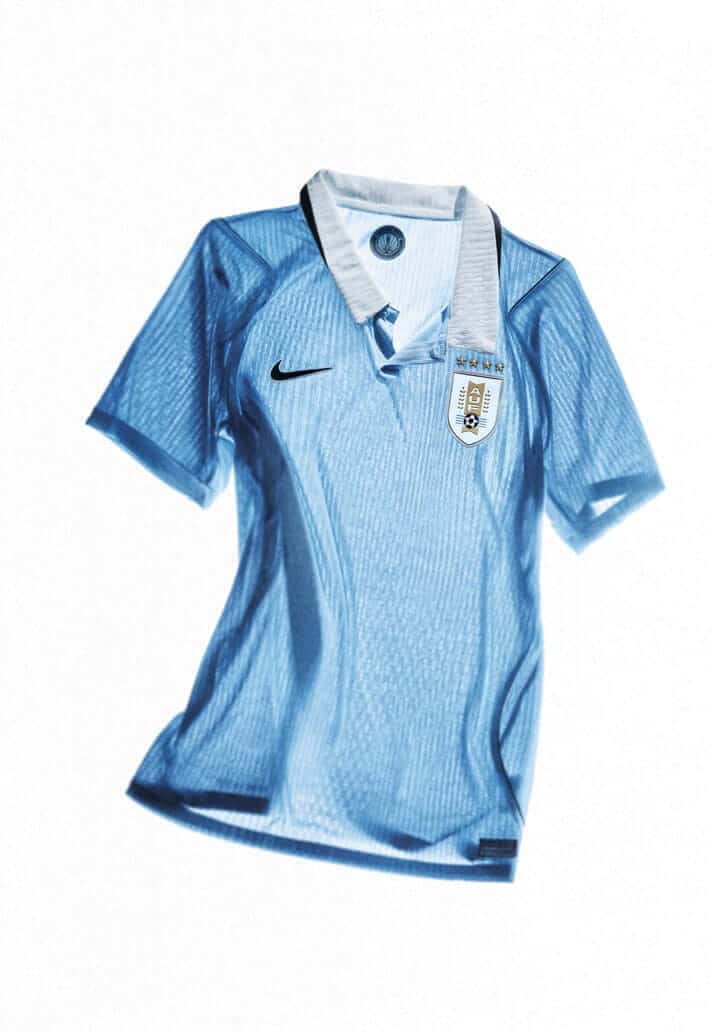
Dri-FIT ADV, Nike's replacement for the Vaporknit fabric used on player-spec shirts, is described like this: "Made for optimal breathability, Nike Dri-FIT ADV technology combines moisture-wicking fabric with advanced engineering and features to help you stay dry and comfortable. Raised knit in high-heat areas provides additional breathability where you need it most."
For their part, adidas player-spec shirts have featured HEAT.RDY technology, or "[an] innovative fabric [that] absorbs moisture, dries quickly and keeps the air flowing while you're moving for a breathable and cooling feel."
Performance fabrics are nothing new. adidas have cycled through Climalite 2000, ForMotion, TechFit, Climacool, AdiZero and Climachill, among others. Puma have given the world dryCELL, ACTV, evoKNIT and Ultraweave.
Before that, Umbro introduced Tangeru in 1934, made of Peruvian pima cotton for greater softness and comfort, and Bukta's Zeebux interlock cotton boasted dye retention properties that were symbolised by a cartoon tortoise flanked by the words "will not run" on neck tags.
Yet neither of these materials could lay claim to being the first performance fabric. That honour belongs to a cellular textile created as far back as 1888, though curiously the fabric was not applied to football shirts, at least those used in the professional game, for some 80 years after its creation.
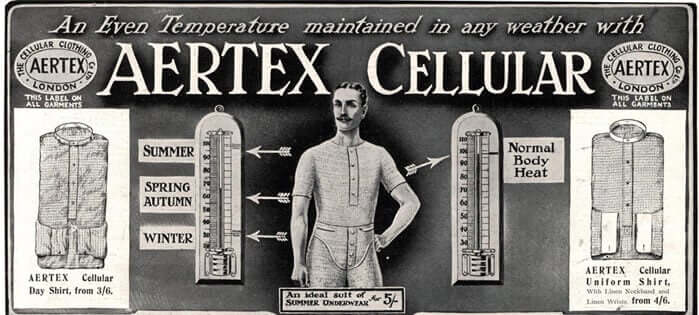
Founded by Lancashire mill owner and politician Lewis Haslam, the Aertex Company's first garments were underwear and men’s shirts. The company clearly saw the potential of their aerated fabric for sportswear early on, however, as a print advertisement from 1895 featured a "cellular athletic shirt" that was "specially adapted for golf, tennis and cricket". No mention of association football, though.
Aertex later gained repute as a supplier to the armed forces, manufacturing breathable khaki drill garments for British and Commonwealth garrisons in the Far East and India that kept the wearer cool in hot climates.
By the 1960s, Aertex fabrics were commonly used for schoolwear across the UK, including school sportswear, but despite clothing student footballers, the brand still had no sway with the professional game. That would change at the end of the decade.
At the behest of England national team manager Sir Alf Ramsey, Umbro began working on a lightweight, heat-conducting shirt that would help players deal with the heat and thin air of Mexico, which was to host the 1970 World Cup finals.
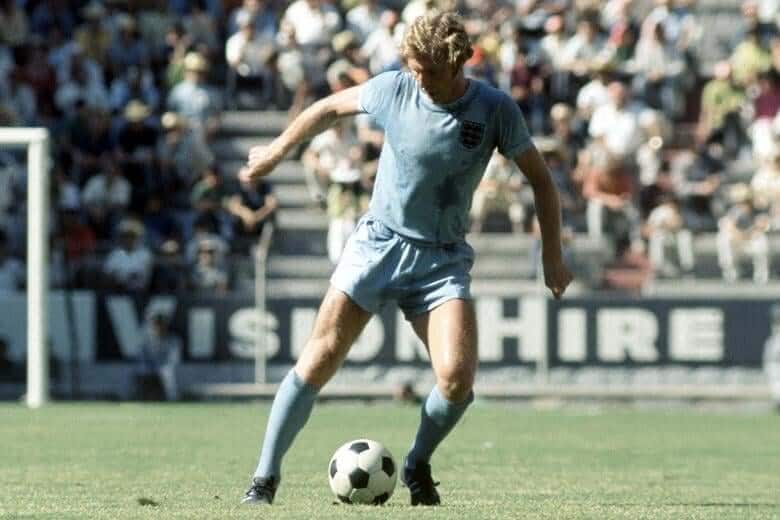
Umbro’s solution was to license the Aertex fabric and produce perforated shirts, which they termed Airtex instead of using the fabric’s proprietary name. Long-sleeved versions were tested in three games of the 1968 European Championships. The first was a quarter-final tie in Madrid, Spain, where the Three Lions won 2-1 to advance to the finals stage in Italy. In Florence, England lost their semi-final match with Yugoslavia 1-0 and concluded the tournament with a third-place match against the Soviet Union in Rome, winning 2-0. In November 1968, red Airtex shirts were trialled in a friendly in Bucharest where England drew 0-0 with Romania.
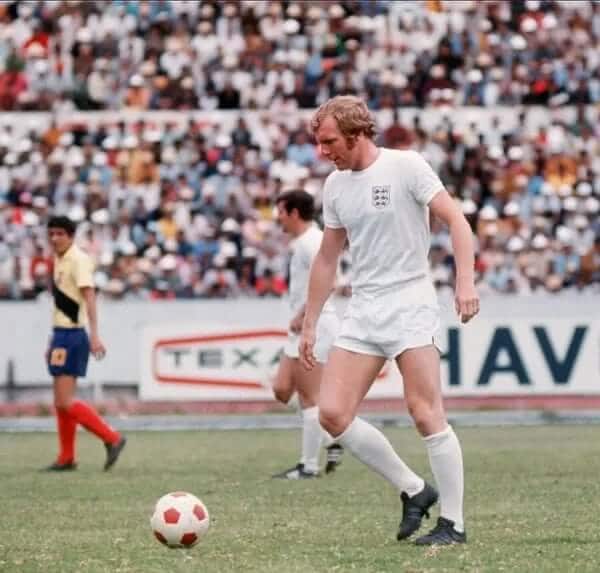
Warm-climate testing occurred the following year, in 1969, when England visited Mexico, Uruguay and Brazil in June. Again, England wore long-sleeved versions of the Airtex shirts. Although England would use the Airtex shirts for a game apiece in 1973 and 1974, it is the 1970 World Cup finals in Mexico that people associate most strongly with the perforated shirts, which by then came in short-sleeved versions.
Ahead of the ninth edition of the finals tournament, the reigning world champions faced Colombia in Bogota and Ecuador in Quito, two high-altitude cities, as England sought to acclimatise before heading to Guadalajara for three group games.
England were drawn into Group 3 in Mexico and kicked off their tournament in all-white against Romania at the Jalisco Stadium, a game settled by Geoff Hurst’s 65th-minute goal. Next up were Brazil, installed as favourites to win the competition, and they went some way to justifying that tag with a 1-0 win in a game remembered for Gordon Banks’ improbable save from Pele’s header, and Bobby Moore’s precision tackle on Jairzinho inside the box. Again, the Three Lions were in all-white, but they changed for the final group game against Czechoslovakia, not that viewers with a black and white TV could tell.
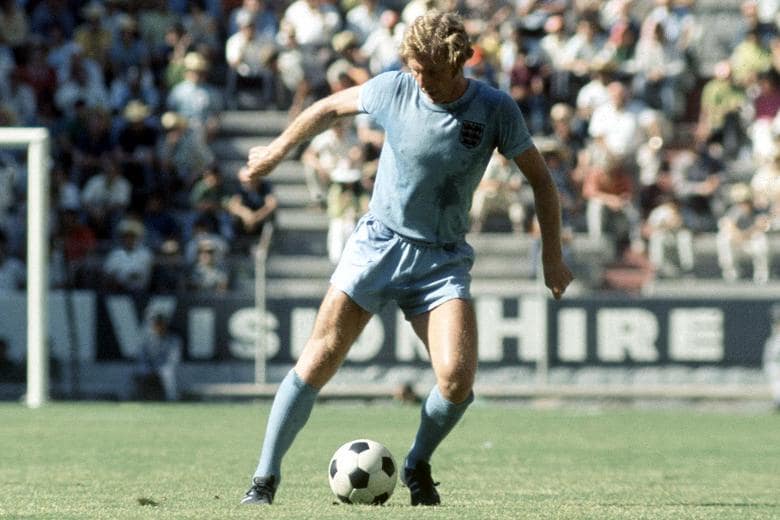
England wore their light blue alternate kit while the Central Europeans wore all-white, two kits that in bright sunshine were hard to distinguish when viewed on a monochrome screen. England won 1-0, an Alan Clarke penalty enough to ensure qualification for the knockout phase.
Hopes for a second successive Jules Rimet Trophy were dashed by West Germany in the quarter-final in Leon. England were, as in the 1966 final, in red shirts with white shorts and red socks, and they must have been confident of progression to the semi-finals when they went 2-0 up courtesy of strikes by Mullery and Peters. However, the West Germans showed tremendous resilience to draw level after goals from Beckenbauer and Uwe Seeler.
As in 1966, England v West Germany went to extra time, but this time the team in white shirts prevailed. A close-range Gerd Muller volley broke English hearts, who at this point might have found the notion of failing to qualify for the next two tournaments inconceivable.
That, however, proved to be the reality. England watched the 1974 and 1978 finals from home on TV, while Scotland jetted off to West Germany and Argentina respectively. In both tournaments, Umbro supplied the Scots with Airtex shirts, and perforated shirts were part of their kit sets until 1982, by which point nylon had replaced cotton and was itself about to be displaced by polyester.
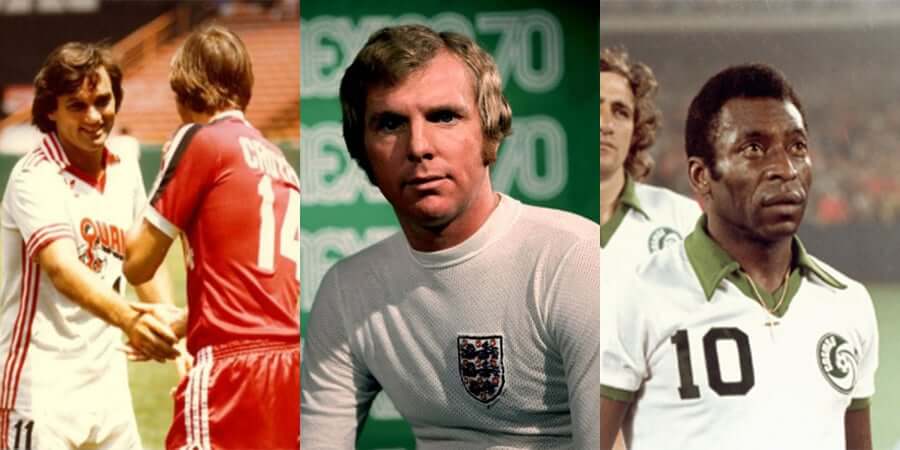
For club sides, Airtex shirts tended to be worn in cup finals, pre-season friendlies and new-season curtain raisers, with regular style shirts worn during the less clement weather months. Teams who wore Airtex at some point include Arsenal, including the 1978 FA Cup final, Aston Villa, the 1975 League Cup final, Chelsea, Derby County, Leeds, the 1972 and 1973 FA Cup finals, Liverpool, the 1977 FA Cup final, European Cup final and Charity Shield, Manchester City, the 1976 League Cup final, Rangers, Tottenham, Watford and Wolves, the 1974 League Cup final.
The Rangers shirt may have been the last hurrah of Airtex, used in 1989 when Umbro were favouring Tactel nylon shirts for hot-weather games. Admiral got in on the act too, though they called their version Airflow, which they supplied to England, Leeds, Manchester United and Wales.
Though the Aertex fabric, 80 years old by the time Umbro applied it to their wares, was late to the football performance fabric party, it certainly burned phosphorus-bright throughout the 1970s and 1980s, and remains one of the most important developments in kit evolution.
Written by Les Motherby.