How a Roll of Striped Fabric Created a Football Shirt Icon
There are football shirts that become classics because of what happened in them. Others age into something more beautiful than they ever seemed at the time. Denmark’s 1986 World Cup shirt belongs to a rarer category altogether. Nearly forty years on, it still looks strange.
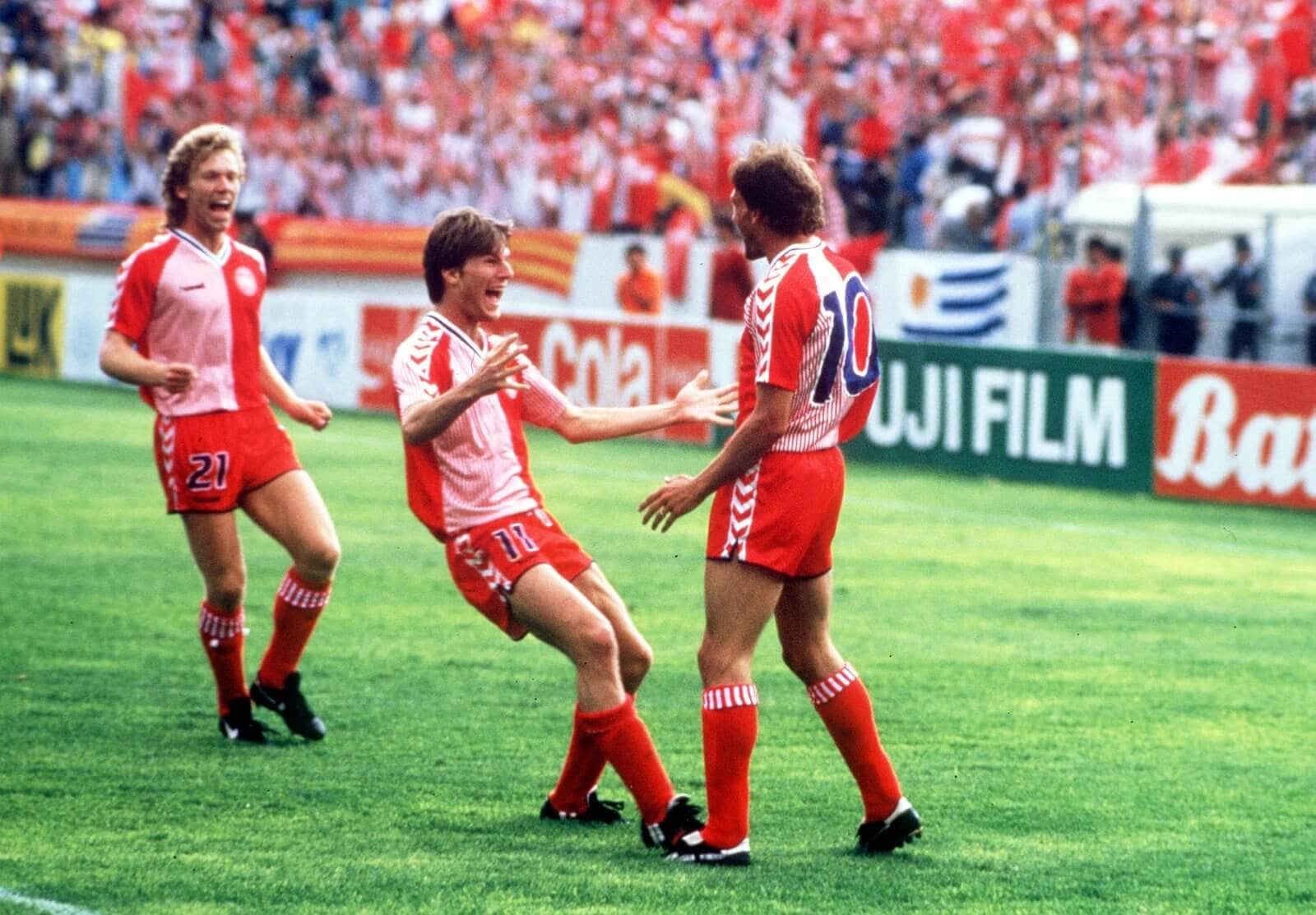
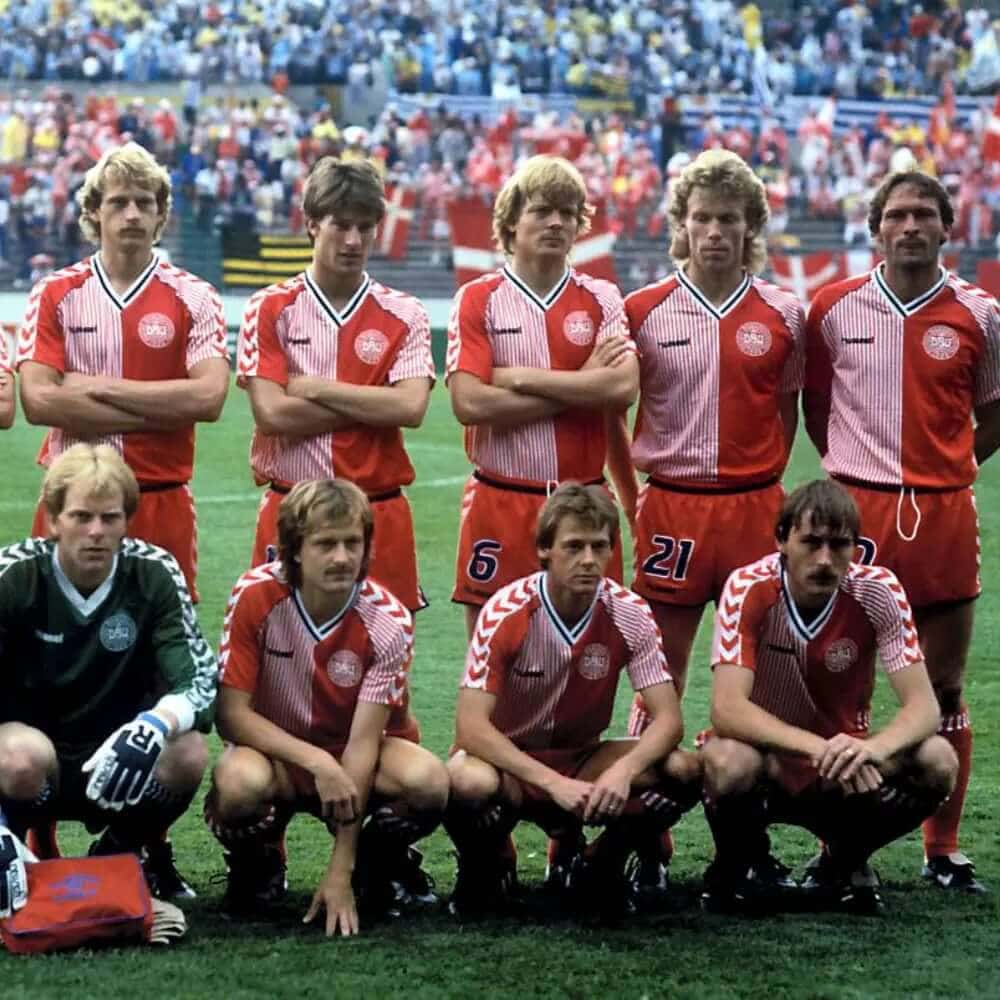
One half is almost entirely white, the other is covered in fine red stripes. The sleeves refuse to match either side properly and instead carry their own red-and-white geometry, finished with Hummel’s chevrons running down the arms. Even now, when asymmetric football shirts are no longer particularly radical, there is something wonderfully odd about it. In 1986, it must have looked as though somebody had stitched two different ideas together and decided not to choose between them.
And that's not actually a million miles from how it happened.
The Denmark shirt was the work of Birgit Leitner and Anne-Mette Ernst, two freelance designers who were working with Hummel during one of the most important periods in the company’s football history. According to Hummel, they were the only designers in-house at the time and were responsible for the brand’s football shirts throughout much of the 1980s, working on kits for clubs including Real Madrid, Tottenham Hotspur and Aston Villa as well as the Danish national team.
It is easy, from the distance of 2026, to imagine a shirt this famous arriving out of some elaborate creative process. Moodboards, brand strategy, etc, etc.. Months of presentations about Danish identity and the visual language of Scandinavian football. The reality was considerably more analogue.
Leitner and Ernst worked with physical fabric samples, putting different materials together by hand and making prototypes in the sewing room at Hummel’s office in Hørning. Ernst later recalled that the pair could spend around 120 days a year travelling in search of inspiration and materials. They travelled east to source fabrics and sometimes returned to Denmark carrying hundreds of kilos of material that would eventually make its way into their designs.
When the Denmark job arrived, there were two obvious requirements. The national shirt needed to be red and white. Beyond that, the designers began doing what they normally did: picking up fabric, combining samples and seeing what worked.
Somewhere in the office was a roll of striped material. They tried it. And that was essentially the breakthrough.
Leitner later told Hummel that they happened to have the striped fabric lying around and decided to work it into the design. The result divided the front of the shirt between a predominantly white panel and a field of narrow red-and-white vertical stripes, with variations of the same idea carried onto the shoulders and sleeves. What now feels like one of football design’s great deliberate statements emerged, at least partly, from the materials that happened to be within reach.
The timing could hardly have been better. Denmark were about to play at a World Cup for the first time.
They had already announced themselves internationally by reaching the semi-finals of Euro 1984, but Mexico ’86 was the moment Danish football spilled properly into the global imagination. Under Sepp Piontek, Denmark had assembled a side containing Michael Laudrup, Preben Elkjær, Morten Olsen, Søren Lerby, Jesper Olsen and a collection of footballers whose attacking style earned them the enduring nickname Danish Dynamite.
The shirt and the team suited one another almost suspiciously well. Both were bold, unfamiliar and impossible to ignore.
Denmark opened their first World Cup with a 1-0 victory over Scotland before producing one of the performances of the tournament against Uruguay. They won 6-1, with Elkjær scoring a hat-trick, and followed it by beating West Germany 2-0 to complete the group stage with three wins from three, nine goals scored and only one conceded. UEFA later described Denmark as making the biggest impact of the tournament’s opening phase, while FIFA still recalls the side as the beginning of a particularly successful period for Scandinavian teams at World Cups.
It is difficult to separate the images now. Laudrup moving through midfield, Elkjær playing with his shirt hanging loose, the Hummel chevrons down the sleeves and that extraordinary red-and-white split flickering across television screens thousands of miles away.
Yet the design itself was not greeted as an instant masterpiece.
Hummel’s own account says the Danish Football Association did not share the designers’ enthusiasm when the shirt was revealed. The reaction from captain Morten Olsen during its presentation on live television was hardly effusive either. His verdict was simply that it was “different.”
In fairness to Olsen, he was right.
It was very different. Football shirts in the mid-1980s were becoming increasingly adventurous, but Denmark’s kit still felt unusual enough to split opinion. Leitner later suggested that this resistance was almost part of what allowed it to become special. Designs that are immediately acceptable to everybody rarely become the ones people are still arguing about decades later.
There is probably something in that. Many of football’s most enduring shirts contain an element that initially looks wrong. Nigeria’s 2018 zigzags were hardly restrained. Arsenal’s bruised banana was mocked before it became an object of obsession. Goalkeeper shirts from the 1990s often looked as though their designers had been given a new graphics package and six hours without supervision. Time has a habit of rewarding the kits that took the bigger swing.
Denmark ’86 did more than that. It became inseparable from the particular team wearing it.
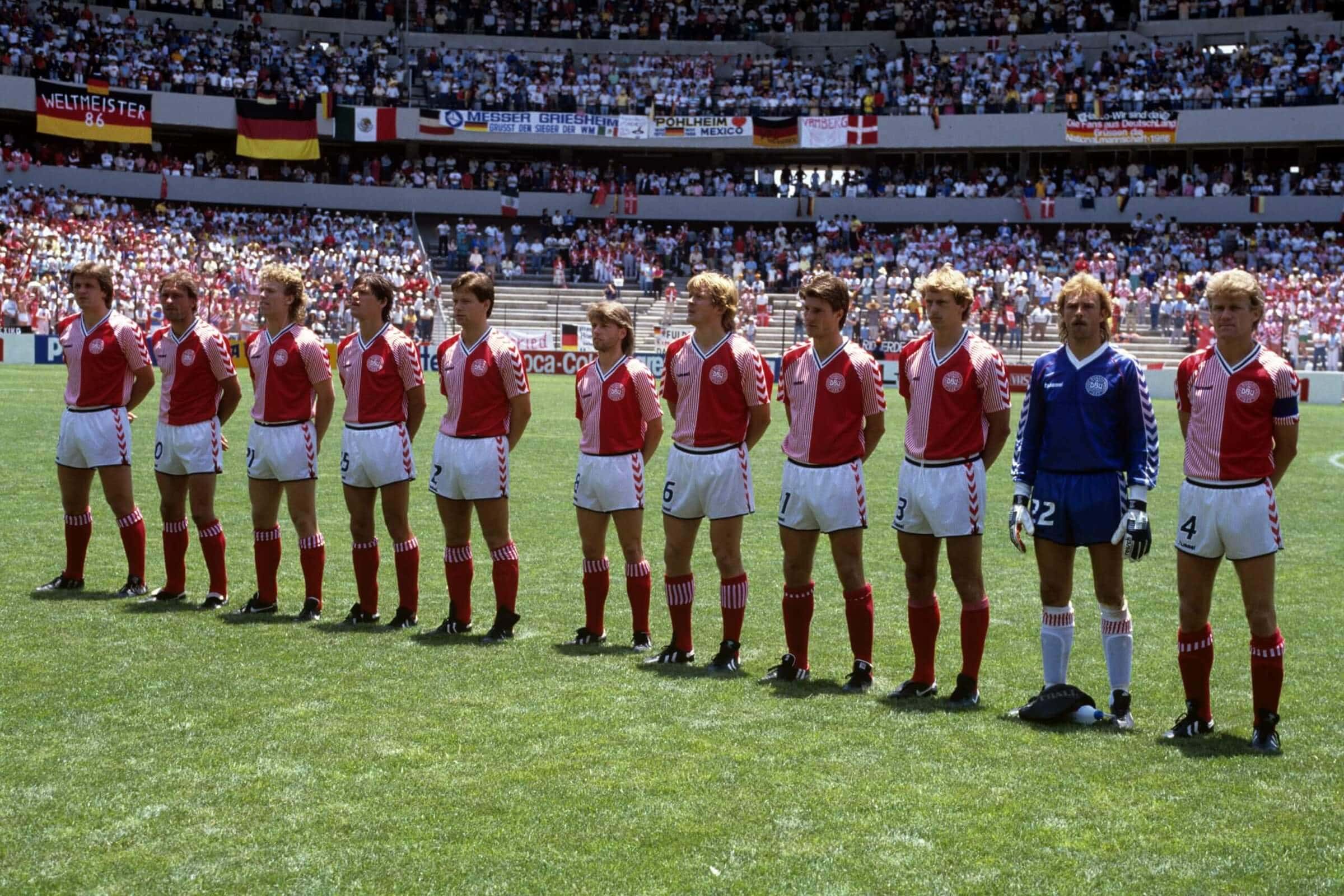
For three matches, everything seemed possible. Denmark had beaten Scotland, dismantled Uruguay and defeated the West Germans, who would eventually reach the final. Their reward was a last-16 meeting with Spain in Querétaro.
Jesper Olsen put Denmark ahead from the penalty spot, but shortly before half-time he attempted a pass across his own penalty area that was intercepted by Emilio Butragueño. Spain equalised and the game changed completely. Butragueño scored four times as Spain ran out 5-1 winners, one of the most startling reversals of the tournament. FIFA still treats the match as one of the defining performances of Butragueño’s career, while the striker himself has said the night changed his professional life.
Denmark’s first World Cup therefore lasted only four games.
The shirt lasted rather longer.
If anything, the brevity of the run probably helped build the mythology. There was no long tournament in which Denmark slowly became ordinary. The whole thing arrived, exploded and disappeared within a fortnight. A brilliant new team in an extraordinary shirt won three games, scored nine goals, looked capable of beating anybody and then vanished in spectacular fashion.
Back home, Hummel realised fairly quickly that the design had escaped the boundaries of a football kit. The company expanded it into a wider collection that included tracksuits, umbrellas and even beach chairs. Ernst and Leitner later recalled receiving photographs from supporters who had painted cars in the pattern. Ernst joked that they should have licensed the design because they might have become rich from it.
That is perhaps the point at which a football shirt stops merely being a football shirt.
The pattern became a graphic shorthand for Denmark ’86. You could remove the crest, the sponsorless chest and even the Hummel logo and people would still know what they were looking at. That is an extraordinarily difficult thing for a kit manufacturer to achieve, particularly with a national team whose traditional colours are among the simplest imaginable.
Hummel has understandably returned to the design repeatedly. In 2023, as part of its centenary celebrations, the company relaunched the 1986 away shirt and Denmark wore it again in a European Championship qualifier against Northern Ireland. Hummel also adapted the famous template for nine of its club partners, demonstrating how recognisable the basic visual idea had become almost four decades after its creation.
Its reputation has only grown in the years since Mexico. Hummel describes the shirt as one of the most iconic designs in football history, and it has regularly appeared at or near the top of rankings of the greatest football shirts ever produced. That sort of retrospective acclaim can sometimes flatten a shirt’s story. Once something has been labelled a classic often enough, it begins to feel as though everybody must have known what they were looking at from the beginning.
They didn’t.
The Danish FA was unconvinced. The captain thought it looked different. The designers were freelancers working with fabric samples in a sewing room in Hørning. They travelled the world buying materials, carried them back to Denmark and experimented with whatever was available. One of those materials happened to be a roll of striped fabric sitting in the office.
From that came a shirt that now belongs to the visual language of the World Cup.
Football shirt history tends to make its greatest designs look inevitable in retrospect. Denmark ’86 is better for knowing that it wasn’t. It came from two designers moving fabric around, taking a chance on something unusual and discovering that the strange option was the right one.
Forty years later, it still is.
This article was developed from original research by Giampaolo / TSPN Calcio, with additional research and writing by Showboat.