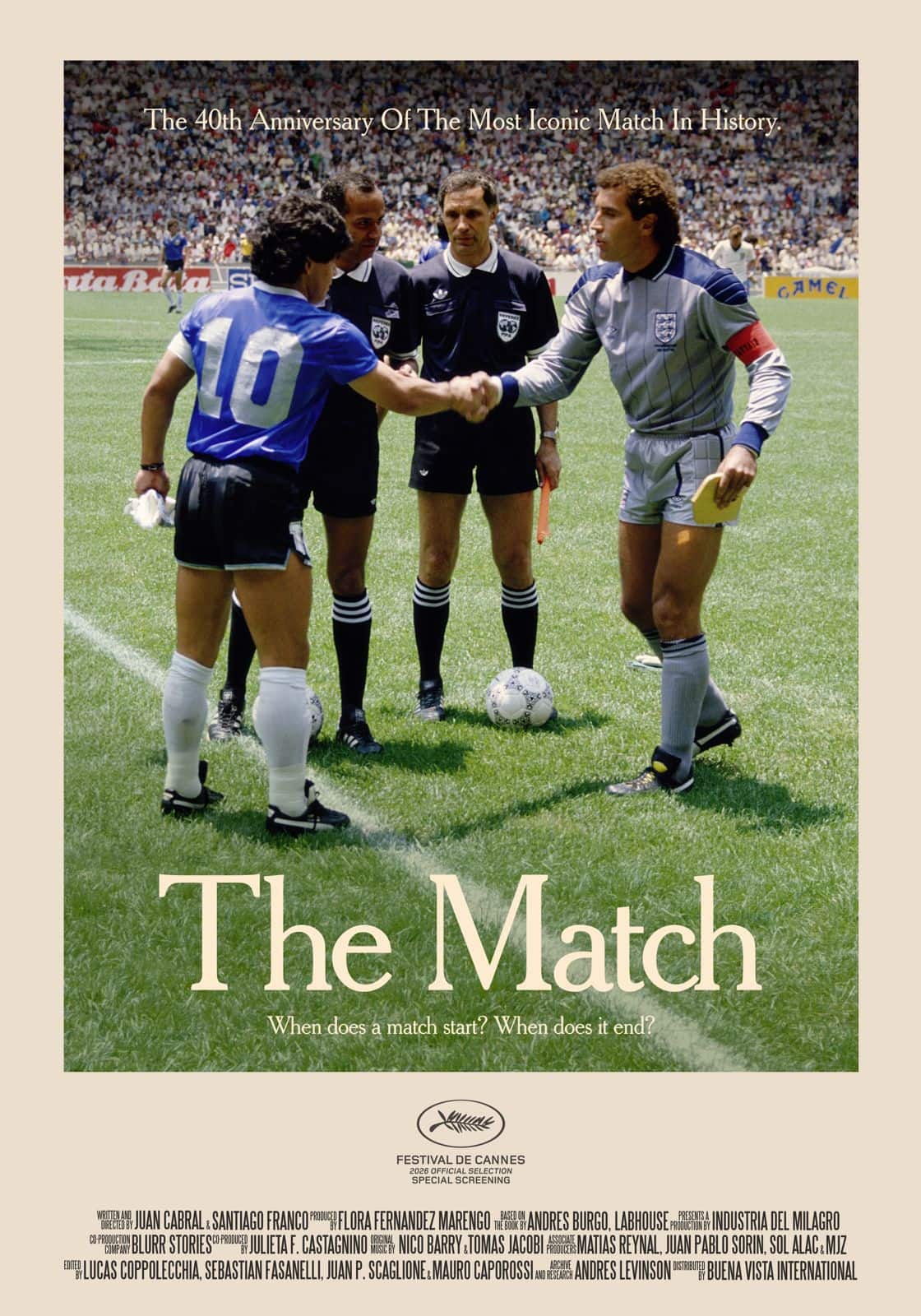
There are very few football matches that can sustain a feature-length documentary forty years after the final whistle, particularly when almost everybody watching already knows what happened. Argentina against England in the quarter-finals of the 1986 World Cup is one of them. Two goals from Diego Maradona, separated by four minutes and seemingly belonging to entirely different sporting disciplines, have been replayed, dissected and argued over ever since. What more could there possibly be to say? Quite a lot, as it happens.
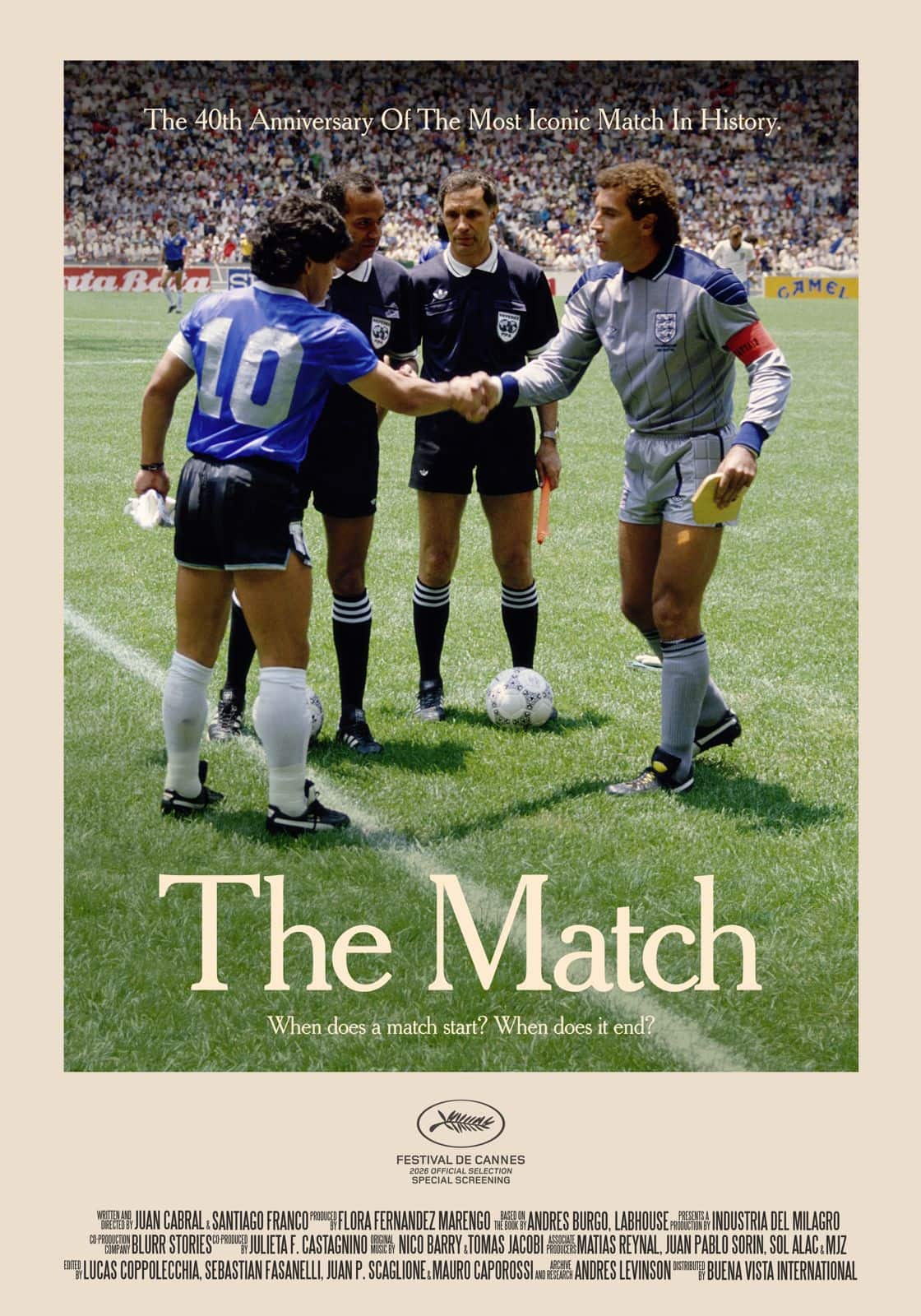
Directed by Juan Cabral and Santiago Franco, The Match is a wonderfully accomplished retelling of those 90 minutes in Mexico City, although calling it a football documentary probably doesn’t do it justice. It’s a film about memory, mythology, national identity and, perhaps more than anything else, the extraordinary power of images.
Gary Lineker is one of our narrators, an immediately familiar and reassuring presence for an English audience. There are few voices more recognisable in British football, and his recollections are delivered with the measured clarity you’d expect from someone who has spent much of his life explaining the game to the rest of us.
His Argentine counterpart, Jorge Valdano, offers something rather different. Sitting in his polo neck, looking every inch the South American intellectual, Valdano speaks about football as though it’s a branch of philosophy. Where Lineker gives us the facts, Valdano gives us the poetry. Both are excellent company, but it’s the latter who provides the film with its wisdom.
There’s a particular Latin lyricism running through the entire production. It’s there in the Argentine players, who seem constitutionally incapable of describing a football match without reaching for something profound. It’s there in the wonderful Argentine commentary, where a goal isn’t simply scored but becomes an occasion for something approaching divine intervention. And it’s there, most movingly, in the words of Jorge Luis Borges, whose writing provides the film with its emotional conclusion. Even Lineker wells up.
You get the impression that the English players remember the match as an extraordinary sporting occasion, while the Argentinians remember it as something closer to a foundational national myth. Neither perspective is necessarily more valid, but the contrast makes for fascinating viewing.
Visually, the film is immaculate. Cabral and Franco have constructed something that feels closer to a beautifully considered piece of cinema than a conventional sports documentary. The interviews are filmed in exquisite black and white, with the former players positioned against enormous screens carrying images from their younger lives. There’s a wonderful sense of these men sitting in judgement of their former selves, watching history unfold from the comfortable distance of forty years.
The aesthetic makes more sense when you consider Cabral’s background. Before moving into feature films, he was responsible for some of the most celebrated advertising of the modern era, including Sony Bravia’s Balls and the extraordinary Cadbury’s Gorilla commercial, in which a gorilla plays the drums to Phil Collins. If you’ve ever wondered what happened to the man responsible for one of the great television adverts of the 2000s, he’s been making beautiful films about Diego Maradona.
That advertising background is visible throughout The Match. Every frame feels considered, every transition purposeful, every image polished to within an inch of its life. At times, perhaps a little too much so. The closing sequence, which brings the former opponents together around a table football game, feels slightly overworked, as though the filmmakers couldn’t resist giving us one final, perfectly composed metaphor for reconciliation.
It’s a minor complaint, but there are moments when you wish Cabral and Franco would trust the material enough to leave it alone. The same applies to the soundtrack, which leans rather heavily on Queen. There’s only so much stadium rock one football documentary needs, even one about a match of this magnitude.
Yet the visual precision is also central to what makes the film so successful, because this is a story that has always existed through images.
Think about the Hand of God. For a brief moment in 1986, the most controversial goal in World Cup history existed largely as a question of perspective. The referee hadn’t seen the offence, the players were arguing about what had happened and millions watching around the world were trying to make sense of it. Then came the photographs, capturing something the television still couldn’t: the image of Maradona’s raised fist, suspended forever beside Peter Shilton’s outstretched arm.
Cabral and Franco understand that these moments belong as much to the history of photography and television as they do to football. Their film repeatedly returns to the question of how events become memories, and how those memories are subsequently shaped by the images we inherit. It’s difficult to imagine either goal carrying quite the same cultural weight had it occurred in an era before television, or indeed in today’s world of endless camera angles, VAR reviews and forensic analysis.
What we’re left with in the film is debate. Valdano, cerebral, makes no apologies for it. “It should be noted that for us cleverness is a value and a value that we sometimes put above honesty,” he says. The archival footage of Maradona goes one further: “When you play in the street like we played in Argentina the goals always counted as long as the others didn’t notice.”
The film also understands that the match itself cannot be separated from the events of four years earlier. The Falklands War hangs over the documentary. The filmmakers provide enough historical context to explain the tensions between the two countries, but wisely resist the temptation to turn a football match into a simplistic continuation of an armed conflict. The distinction matters, particularly when dealing with an event that has so often been presented as an opportunity for sporting revenge.
Instead, there’s a quiet sadness to these passages. The players were footballers, not soldiers, and the young men who died in the South Atlantic had considerably more at stake than anybody running around the Azteca Stadium. The film handles this with admirable sensitivity, acknowledging the national emotions involved while making room for something more universal: the terrible futility of war, and the absurdity of ordinary people being asked to kill one another in the name of competing flags.
It’s here that the documentary finds its most affecting voice. Towards the end, Valdano reads Juan López and John Ward, a prose poem by the Argentine writer Jorge Luis Borges, published in 1985. It tells the story of two young men, one Argentine and one British, who share an appreciation of each other’s cultures. One reads Cervantes, the other Conrad. Under different circumstances, they might have become friends. Instead, they meet on the Falkland Islands, where both die fighting a war neither had any real reason to want.
It’s an extraordinarily moving piece of writing, and a beautiful choice with which to bring the film towards its conclusion. After all the noise, the nationalism, the arguments about cheating and the endless revisiting of footballing grievances, Borges reminds us of the rather more important things that connect people. There’s something especially poignant about hearing those words delivered by Valdano, a man who played in a match that has been burdened with political symbolism for four decades.
For all its occasional indulgences, The Match is an exceptional piece of filmmaking. It finds freshness in one of football’s most familiar stories, allowing its protagonists to revisit events that have followed them for most of their lives. The former players are older now, their grievances softened by time, although not necessarily forgotten. Shilton still has his reasons for feeling aggrieved, while the Argentinians seem largely comfortable with the peculiar circumstances of their most famous victory. The English got plenty belonging to Argentina, they reason. Including Maradona’s iconic shirt.
Maradona himself is the film’s great absent presence. His genius, his mischief and his contradictions are everywhere, even though he is no longer around to contribute. In some ways, that’s fitting. He was always a figure who existed somewhere between the real and the imagined, a footballer whose achievements were so extraordinary that ordinary language struggled to contain them.
What Cabral and Franco have achieved is a film about a football match, certainly, but also about the stories nations tell themselves, the extraordinary durability of sporting images and the strange ways that history continues to live through them.
The Match received its UK premiere at BFI London Film Festival and will be released in cinemas on 20 November.