Ian Greenhill is someone whose work you’ve probably admired for years without realising who he is. The creative studio he co-founded, Studio Something, have continuously pushed the envelope of how football should present itself to fans. Studio Something’s latest work is a three-part documentary called Ultras on the BBC that’s courted both controversy and acclaim. We caught up with him recently to delve into the questions the documentary poses on accessibility in the game and the power of the ultras in Scottish football.
Tell us about Studio Something, your role in it and the projects you’ve been working on…
I’m the co-founder and CEO, which sounds grander than it is. Basically, I set up a creative agency with my best mate Jordan. We were working in an advertising agency in Edinburgh doing the stereotypical stuff, making ads for brands like Irn-Bru and people like that. Then, in our spare time, we started making music videos. We’d sneak off at the weekends and shoot these bigger-budget videos for Island Records, Universal, people like that, and we started making more money doing that than our day jobs.
So we decided to combine the two things and create what we didn’t know at the time was essentially a content agency. Since then we’ve made A View From the Terrace, which is a fan-led Scottish football show, and done that for eight seasons for the BBC. It’s a bit like when you get caught smoking and your mum says, right, you’re going to smoke the whole pack. It was like that with TV. Oh, you want to make TV? Well make eight series of this topical football show. It’s actually really difficult.
Was football always central for you?
I support Hearts. My whole family support Hearts apart from my oldest brother, who supports Hibs, which is completely mental to me. It seems mad.
When I was younger I didn’t go to many Hearts games because I played so much football myself. Saturdays and Sundays I was always playing, so I grew up playing rather than watching. Then, as you get older, you start going more, and I had a season ticket at Hearts for many years. Jordan did too, so that was one of the things we bonded over.
I think a lot of people from the outside looking in look at Hearts and what they’re doing now and go that would be amazing for Scottish football, and I think it would. It’s got people talking about the league in a way they maybe weren’t before.
My dad supported Hearts his whole life and he’s 70. The last time he saw Hearts win the league he was four years old. So if it ever happened it would be incredible.
You’ve said something changed in Scottish football after Covid. What did you start noticing?
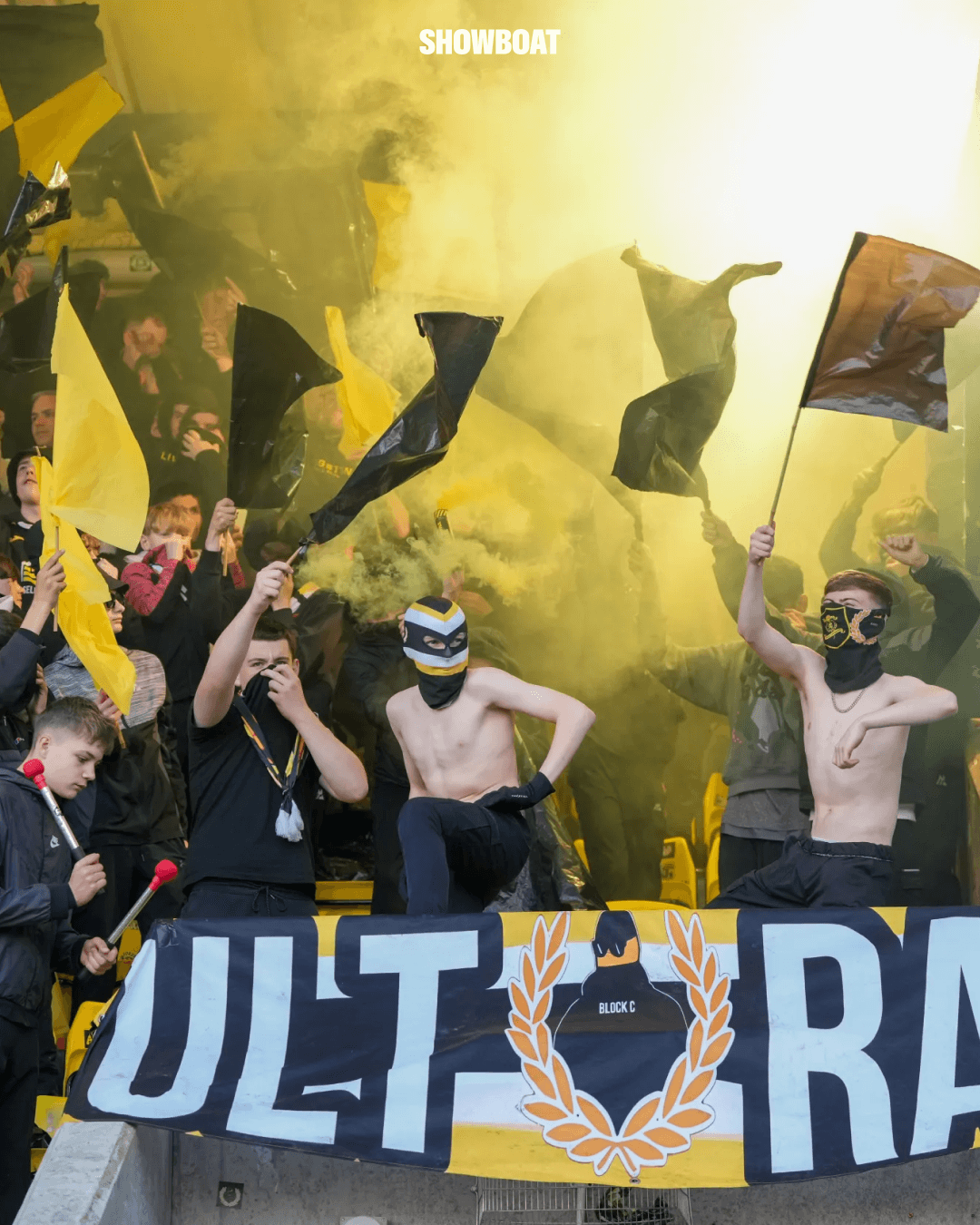
Scotland’s had ultras for quite a while. You’ve always had bigger scenes at clubs like Celtic, Rangers, Aberdeen. But what we noticed, especially filming at lower league grounds, was that suddenly there’d be ten lads with a drum at places you would never have expected. And you thought, that’s really interesting.
People seemed to be coming out to support their local team and mimicking some of the ways ultras behave. Then in the top league as well, every team seemed to have an ultras section of some kind, which felt relatively new.
They’re quite different to ultras on the continent. They’re younger, more grassroots, more in their infancy. But it felt like one of the few things in this world of individualism, TikTok and the manosphere that was actually bringing young men together collectively at the weekend.
At its purest, it’s arts and crafts and singing and raising money for local causes. At its worst, there are obviously bad elements. A lot of people don’t agree with pyro, fighting, all the rest of it. We just wanted to look into why it was happening and what people were being drawn to in it.
What do you think young people are actually being drawn to?
I think it signals a bit of a democratisation of football. In some parts of the game now it’s really expensive for young people to get involved. If you’re a Hearts fan, for example, you can’t even get a season ticket at the minute. So if you’re a young kid you might think, right, I can’t get a ticket there and I can’t afford all this, so I’ll go to one of these smaller local teams and pay three or five quid instead.
And if you’re doing that, you don’t just want to stand there quietly watching lower league football. You want to create something around it. I think that’s what a lot of these groups are doing.
A lot of it came through YouTube too. Clips of ultras doing things online. It was almost democratised in the way it was beamed into people. So if you’re a wee guy watching that, you think, that looks cool, I could do that.
For a lot of people, though, the first thing they see is the smoke, the balaclavas, the noise. It can feel intimidating...
It is intimidating. Of course it is. If you see groups of young people with drums and pyros and balaclavas, it’s going to feel intimidating. I think people are often intimidated by groups of young people in general, and then all that stuff just ups the ante even more.
We’ve got ultras at the end of our road. I live in a nice suburban part of Edinburgh and you can hear the drums from the pitch. My wife was like, what’s that? And I was like, that’s ultras. That’s what we’ve been making a documentary about for a year.
But one of the things we wanted to do with the documentary was explain it a bit better to people who aren’t close to football. We’ve had messages from mums and from people who just weren’t aware of the scene saying they understand it more now. That was really the aim.
It’s easy to judge it by its cover because the cover can look quite scary. But we wanted to show that, in some cases, it can be a good thing and that there are ways young people can be introduced to it in a responsible and interesting way.
Social media feels central to all of this. Is it just documenting the scene, or does it help create it too?
Yeah, I think social media is part of it. We look at that in the documentary through Blair, the YouTuber who appears in it. There’s been criticism of him, with people asking whether kids are performing a certain way because he’s there filming them.
We wanted to look into that properly. What motivates him, what makes him want to go and film these young ultras, and whether his channel is documenting something that already exists or helping create it.
That was quite a polarising part of the documentary because it raises a real question. Are you documenting something, or are you encouraging it? It’s hard to know sometimes what came first.
You didn’t have cooperation from every major ultras group. Does that mean there’s still a version of this story that hasn’t been told?
Yeah, probably. There were some bigger ultra groups who didn’t cooperate. That’s fine, but it does mean there are probably other versions of this story still to be told.
At the same time, we were never trying to make some Inside Ultras thing, some Danny Dyer-type documentary. The film was more of a question. We were really interested in the rise of young ultras and lower league ultras, so that’s where we focused our attention.
We followed Jayden, who starts off at his local community club Spartans and aspires to become a Hibs ultra0p one day. We had Derek and John at Motherwell, where we wanted to look at how ultras groups mirror the culture of the town they come from.
And then there was Manpreet, the Partick Thistle capo, who was brilliant. A young Asian capo in Scotland is just a really interesting story in itself. I think your assumption of what a capo is might be one thing, and then someone like Mantas is almost the complete opposite of what people expect.
Where do clubs stand on it all? It feels like they want the atmosphere, but not always what comes with it.
It depends on the club. Some support the groups, some keep them at arm’s length. St Mirren and Falkirk, for example, work quite closely with their ultras. Hearts and the Gorgie Ultras have a relationship now too. Rangers are probably the biggest example of a club that’s collaborated with that kind of support.
It’s a tricky subject, but I don’t think it’s going away. In my opinion, clubs are going to have to work out how to collaborate with these groups, more like they do on the continent, because they’re not disappearing.
I read about Cillian Sheridan and he was saying when he was playing abroad, the ultras basically stopped him going out for a drink because he wasn’t playing well. They were like, you’re not going out until you sort it out! That’s the level of control in some places.
If you look across Europe, ultras are much more embedded in the identity of clubs. In Britain that still feels alien. People can’t quite compute it. But I do wonder if, as the scene grows in Scotland, clubs will have to find ways to engage with it rather than just react to it.
Can these groups be managed, or do they naturally drift towards something more extreme?
That’s a hard one to answer. There are always going to be people who try to co-opt something for their own gain. But one of the things we try to get across in the documentary is that ultras groups often mirror the culture of the club or the town they come from.
Sometimes you don’t quite realise what that culture is until you see it reflected back through an ultras group.