England have a midfield problem and it's probably not the one you think.
Another summer of dreaming that England would go all the way and win the World Cup came crashing down when Argentina brutally burst their bubble on Wednesday night. The post-mortem is well underway and is likely to last weeks rather than days. The FA have already briefed that Thomas Tuchel is their man and will remain in charge, but much of the media are unconvinced.
Many sportswriters are now calling for his dismissal, not just because of England’s second-half collapse but because the manager ended up doing the very thing he criticised Gareth Southgate for: retreating instead of attacking. By bringing on a central defender for Anthony Gordon, Tuchel stripped his team of virtually all attacking threat. It worked against Mexico. Foolishly, Tuchel thought he could get away with it again. But Roberto Alvarado crossing the ball into the box is a very different proposition to Lionel Messi crossing the ball into the box.
Tuchel had the front to claim afterwards that his tactics were not to blame and that England’s 12% possession after taking a 1-0 lead was not the result of his approach. Instead, he suggested it was “not in our [English football] DNA like it is in Spanish DNA or in Argentinian-Brazilian DNA, to take the ball and control the game with the ball”.
There’s sense to this, but only to a point.
The one player in the squad who keeps the ball better than anyone else, Kobbie Mainoo, wasn’t given a single minute at this World Cup. Adam Wharton, another technician, was left at home. Alex Scott, a player who’d walk into most Premier League starting XIs, was also left behind. Tuchel picked his squad based on running power and physicality rather than thought, then complained England lacked composure. It was a problem entirely of his own making and one multiple England managers have repeatedly fallen into. Most England fans fall into it too. There was no public outcry when Wharton or Scott weren’t called up this summer.
Most England fans looked at the World Cup squad and said England didn’t have enough creativity or enough difference-makers. They were, of course, referring to the mercurial talents of Phil Foden and Cole Palmer. The merits of leaving those players at home have already been discussed. Tuchel wanted to get the best out of Harry Kane, England’s only truly world-class player. That’s a perfectly reasonable idea.
Argentina slowly learned that the only way to maximise Lionel Messi was to build everything around him. Out went the other superstars and in came the runners. It worked. Tuchel wanting to play wingers who hugged the touchline before sprinting into the space vacated by Kane wasn’t the problem. The issue lay further back.
England have a number #10 who isn’t from the traditional mould. Historically, that shirt has belonged to dreamers and romantics. Players of touch and grace, players who float and drift. Players capable of picking a pass and unlocking a defence. England have a bulldozer in Jude Bellingham. He possesses many admirable qualities, but they’re qualities of force rather than finesse.
And so a problem began to emerge, though not an insurmountable one. England had wingers who weren’t especially creative and an attacking midfielder who wasn’t particularly creative either. Harry Kane could compensate for much of that because of his quality on the ball and his intelligence. What he, and those around him, couldn’t compensate for was receiving the ball too late.
This is true of almost every elite footballer. Give them the ball quickly in transition and they’re away, free to cause havoc. Give them the ball half a second later and the defence is back in place. Suddenly every attack becomes far easier to crowd out.
This is a long way of saying England’s creativity problem wasn’t actually in the forward positions. It was in central midfield. And it’s an issue that’s hampered English football for decades.
Think back to the so-called Golden Generation. Sven-Göran Eriksson shoehorned David Beckham, Frank Lampard and Steven Gerrard into midfield alongside one deep-lying player, Owen Hargreaves. Hargreaves was elite off the ball - a disrupter, a tackler, a harrier - but on it he would take three touches in almost every situation before finding a team-mate. A first touch. A second to move it out of his feet and decide where it was going. Then the pass.
It may seem minor, but building a midfield around a player this technically limited was a flawed choice rooted in conservative logic. We have all these world-class attacking players, so we need a destroyer behind them. In went Owen Hargreaves and out went Michael Carrick.
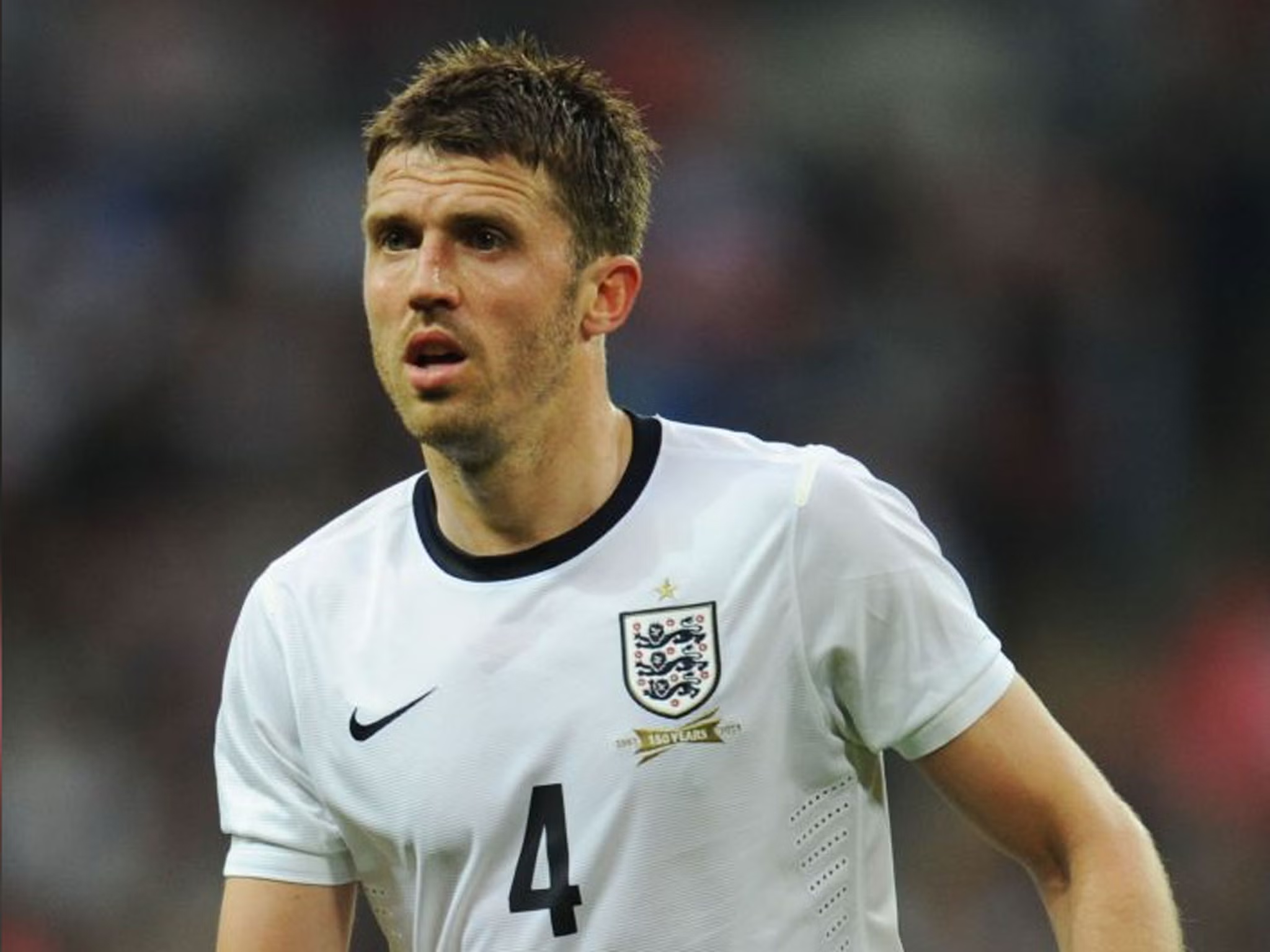
Carrick was central to arguably Sir Alex Ferguson’s greatest Manchester United side, yet he was consistently overlooked by England. Ferguson understood that the modern game rewards technicians more than tacklers in midfield. The quicker the ball is fizzed into the feet of your best players, the more dangerous they become.
It’s no coincidence Lampard and Gerrard never reached the same heights for England as they did for their clubs. It wasn’t about pressure or confidence. They simply never played in a team that fed them the ball in the same way.
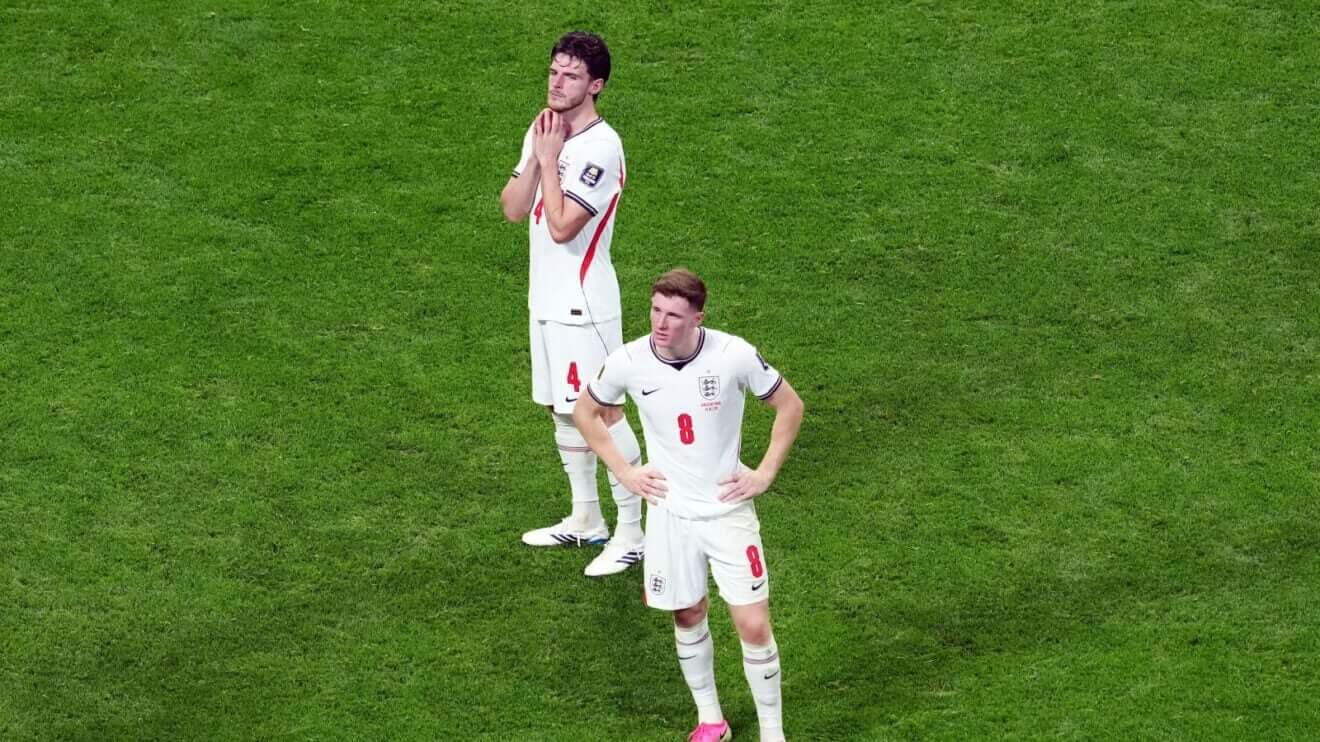
Fast forward to Gareth Southgate’s England and the same problem persisted. Declan Rice became his go-to holding midfielder because he was athletic, aggressive and reliable. Little thought was given to whether his lack of creativity might become an issue because this is the English way. He can keep it simple, went the logic.
But three touches isn’t simple. It’s slow.
The Catalans don’t talk about Sergio Busquets’ “half-touch” for nothing. The ball was gone, moved on to far more devastating players, before you could even think about nicking it from him. Think of Declan Rice receiving possession and you picture a touch, another touch out of his feet and then a 20-yard pass to an advanced full-back.
It’s fine. Safe, even. But by then the opposition are set. Busquets? The ball had already gone. The opposition were never set.

That mindset has hindered the England national team for decades. Adam Wharton made the 2026 World Cup squad, but he was never given serious consideration as England’s deepest midfielder. Instead it was Rice and Mainoo in a double pivot, with Rice continually receiving possession from the centre-halves. It was cumbersome.
Never once did it seem to cross anyone’s mind that Rice doesn’t perform this role for Mikel Arteta’s Arsenal. Even Arsenal don’t trust him there. They wanted Martín Zubimendi. Now they want Bruno Guimarães. This simply isn’t Rice’s role.
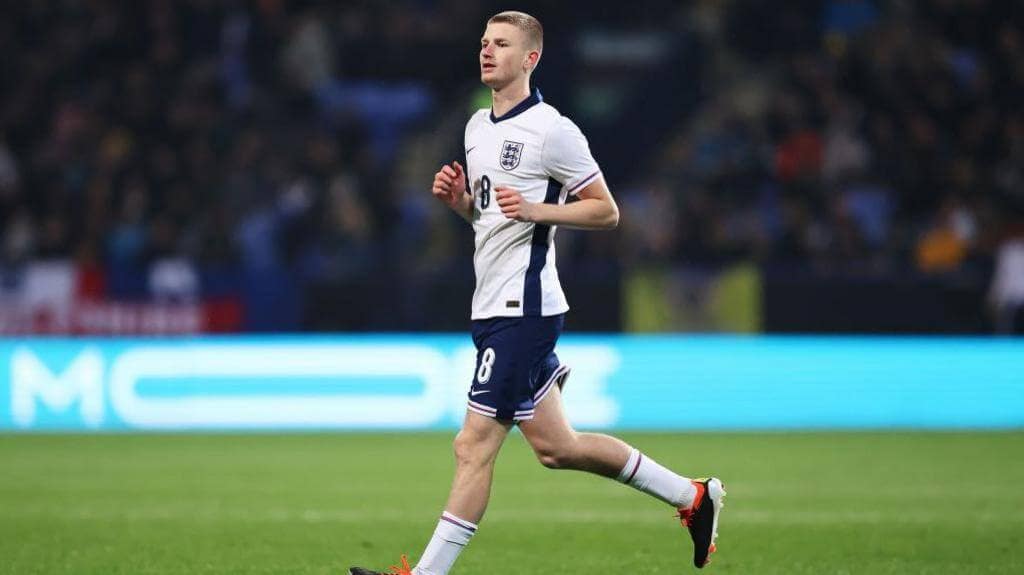
So here we are, four more years on. Elliot Anderson is now the man, with Rice pushed further forward. Anderson is more of a progressive passer. He grew up as an attacking midfielder and is considerably more comfortable on the ball than either Hargreaves or Rice. He wants to play forwards. It’s why Manchester City have just paid £116 million for him.
But England’s midfield problem hadn’t disappeared. Anderson isn’t particularly smooth when he receives possession. If he isn’t a three-touch midfielder, he’s still a two-and-a-half-touch one. He’s known more for his ability to cover ground than reign over it. Adam Wharton is at least one notch above him technically. Michael Carrick was several.
If your deepest midfielder is more N’Golo Kanté than Sergio Busquets, then you cannot also have two runners ahead of him.
So is Declan Rice to blame even when he’s playing in his best position? If you’re pairing him with an athletic number ten in Jude Bellingham, then yes.
England lacked finesse in the middle of the pitch to break down low blocks. That was evident throughout the 2026 World Cup. It also meant they couldn’t keep the ball when they came under sustained pressure against Argentina.
The idea that this problem would simply disappear against stronger teams who leave more space was equally flawed. England struggled to keep the ball for long enough to hurt elite opponents because they lacked enough technical security in central midfield.
Leaving Adam Wharton at home this summer - a player who could have dovetailed perfectly with Anderson - was Thomas Tuchel’s biggest mistake when it came to the creative output of his side. Leaving Kobbie Mainoo on the bench - a number eight who’s almost impossible to rattle in possession, even in the biggest arenas - should prove to be his undoing as England manager.
Football remains a technical sport every bit as much as a physical one. Until England realise that, history will continue to repeat itself.
Lee Kelleher.