
As part of a new series - and with the World Cup approaching - we look back at iconic performances that got teams over the line and on the plane to the world's biggest tournament. England's infamous night in Rome, almost thirty years ago, was the biggest game of many of the players' lives at that point. For some, cruelly, it was also a farewell of sorts before they even knew it.
England’s 1998 World Cup qualification hopes hung on Rome. They were staring down the barrel of failure to qualify for successive World Cups. They hadn’t been to one since 1990. And that was in the days of black and white tellies, wasn’t it? At the time, it felt like the biggest game England had ever played in.
The images bring back details you don’t remember. Glenn Roeder as a young coach on the England staff, Roy Hodgson helping out as a translator for Glenn Hoddle. The palpable threat of violence in the stands. Italy were a serious outfit. Nesta, Cannavaro, Maldini, Albertini, Vieri. A young lad called Del Piero you might have heard of. England didn’t quite have the same aura, especially with Alan Shearer out injured.
But they found a way. Gazza’s ability to receive the ball anywhere and relieve pressure was invaluable. Ian Wright ran the Italian backline ragged and was unlucky not to get the goal his performance deserved. Paul Ince, meanwhile, was colossal. Even Albertini’s elbows couldn’t stop him on the night. The stadium security did their best, though. An underhand tactic was used by the Italians when Ince required stitches and access to the England changing rooms was needed - they hid the keys. It led to one of the most iconic images of a player in England shirt - Ince pouring with blood with a bandage round his head - but was also an unprofessional face that meant he was off the pitch for eight long minutes, much to the fury of Glenn Hoddle. "It's amateur hour that they locked the doors," Steve McManaman recalled afterwards. "It's like on a Sunday league pitch, to protect their valuables."
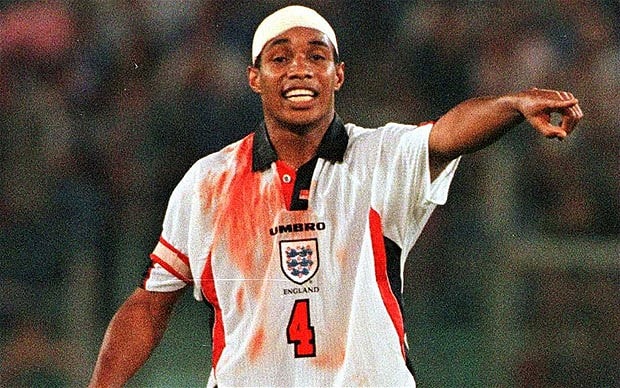
“We had expected less of England,” admitted Maldini. “They played differently.” England were streetwise off the ball and canny on it - things we'd not seen before from the Three Lions when the chips were down, virtues that fuelled a belief that this was more than mere entry to the World Cup, but an emergence as a genuine contender.
When the full-time whistle went it felt like England were back, allowed to dream again. Hoddle had to correct himself afterwards when he talked of victory. ‘It feels like we won,” he grinned. The images at full-time capture a snapshot of absolute joy, total relief - things that are only ever temporary. It was a high many of them would never experience again in an England shirt.
Ian Wright didn’t make the plane for France. Gazza, a player at the heart of all things England did best in Rome, was left out. Paul Merson recalled how he entered the room after Hoddle had told Gazza the news. “It was smashed up, everything turned over. I took three steps in, he said ‘you’re going’ and then I just walked out. Honestly, he smashed the place up like you could not believe."
That night in Rome, unexpectedly, served to renew a cycle of hope and pain for England and its players. Hoddle was right, it was a victory. But, for many involved, it was a bittersweet one.
We also think you'll like...