
For Argentina, the 1990s were a decade of defiance and reinvention.
That was as true on the pitch as it was off it. The country emerged from crisis and the illusion of prosperity only to face something more uncertain, a decade defined by sharp turns and broken promises. Football carried those same contradictions as it navigated its own transitions, caught between past glories and an unclear future.
Italia ’90 felt like the last stand of an old world. Maradona, battered, hunted and increasingly immobile, dragged Argentina through the tournament on reputation, willpower and sheer defiance. Matches were grim, joyless affairs, played in the shadows of his physical decline, but the country watched anyway, recognising something of itself in the struggle. When Maradona finally limped off in tears after the final, it felt like more than defeat. It was a nation seeing its own vulnerability reflected back at it on the biggest stage.
Success did not disappear overnight. Copa América titles in 1991 and 1993 offered proof that Argentina could still win without its messiah. The football was functional, disciplined and often unspectacular, but a trophy is a trophy. They suggested a side learning how to live without Maradona at the centre of everything, even if his presence still hovered over the team like a ghost. These were victories built on control rather than chaos, order rather than inspiration.
USA ’94, then, felt like one last dance. Maradona returned leaner, sharper, and briefly reborn. His goal against Greece, a thunderbolt lashed into the corner before an explosion of raw emotion, gave the country a fleeting glimpse of what was still possible. For a moment, the mythology flickered back to life. But the illusion did not last. He turned out not to be the messiah but a very naughty boy. The failed drug test that followed was less a scandal than a final reckoning. It made clear that the era of Diego, and the old Argentina he represented, was truly over.
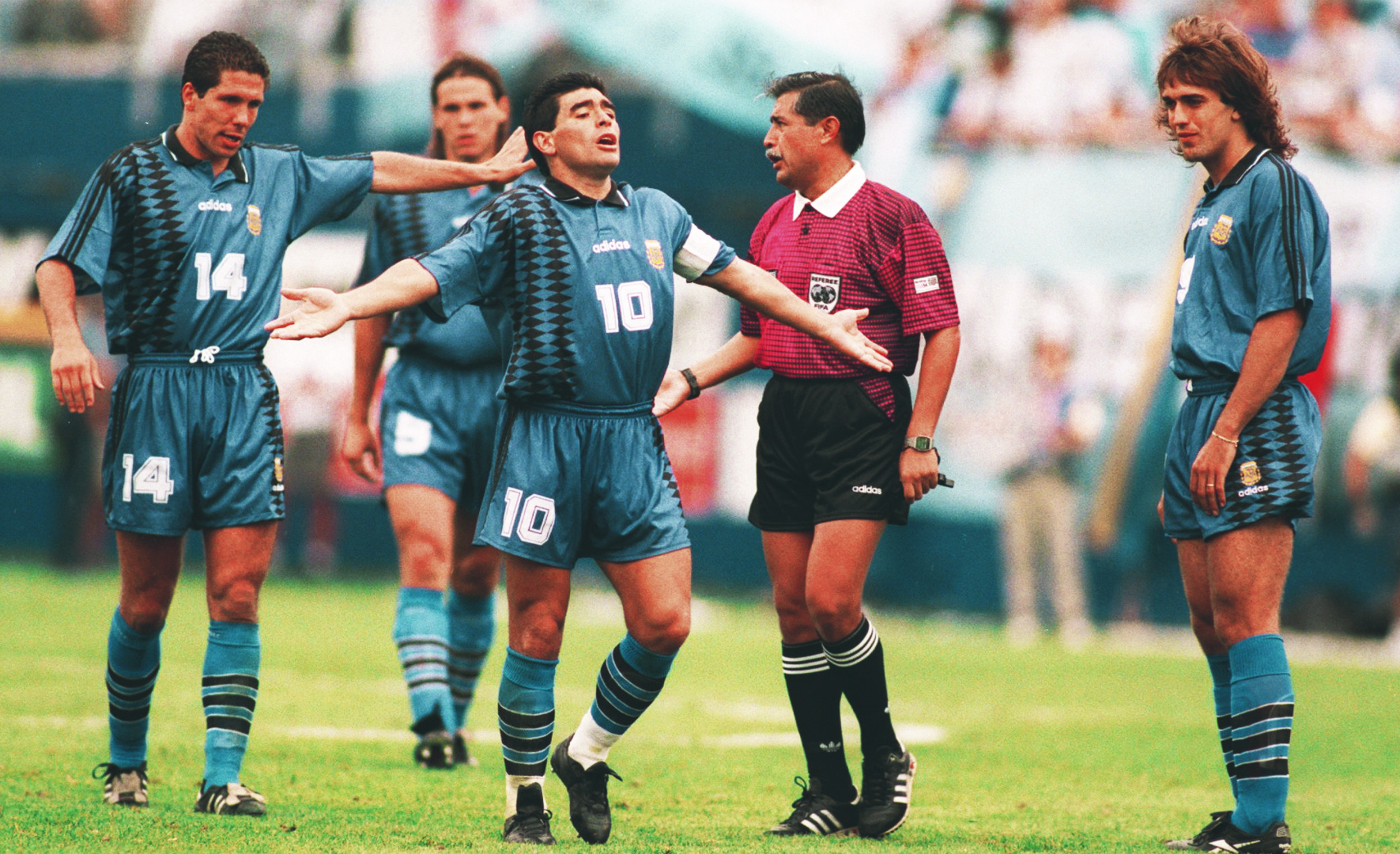
By France ’98, the outlines of a new Argentina were visible. Zanetti, Ayala, Simeone, Gallardo, Verón, Ortega, Crespo and Batistuta offered a future built on balance and quality across the pitch rather than reliance on a single genius. It was a strong, technically gifted side, capable of playing with control and authority. And yet, for all its talent, something felt missing. The team resembled a great band without its talismanic frontman, technically accomplished but lacking that one figure who could bend moments, referees and entire tournaments to his will.
The defeat to the Netherlands in Marseille reinforced that sense of incompleteness. Argentina were competitive, composed and ultimately undone by a flash of individual brilliance from elsewhere. It was a familiar story by then. The margins were fine, but the absence was felt.
And so the 1990s left Argentina suspended between eras. It was the final act of Maradona’s mythology and the first flickers of what would become Riquelme, Messi and the 21st century. The decade belonged fully to neither past nor future. Caught between memory and modernity, Argentina’s football remained a mirror of the nation itself: passionate, political and gloriously imperfect.
We also think you'll like...